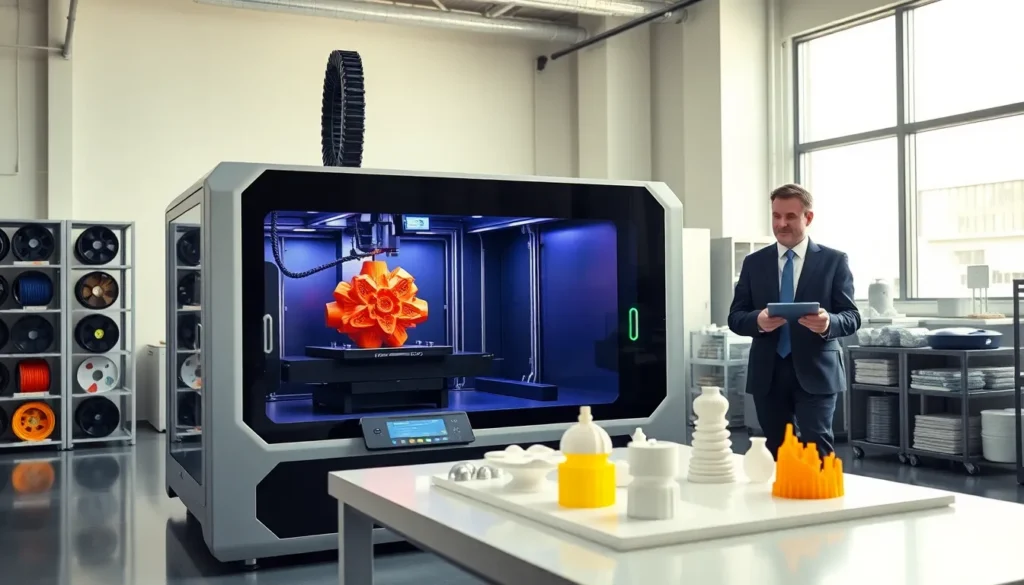
The 3D printing trends 2026 will bring are set to reshape manufacturing, healthcare, and design. The industry has moved well past its early hobbyist phase. Today, companies use additive manufacturing for everything from aerospace parts to custom medical implants. But 2026 promises something bigger: smarter machines, greener materials, and production methods that put factories closer to customers than ever before.
This article breaks down the key 3D printing trends 2026 will deliver. From AI-powered design tools to sustainable filaments, these shifts will affect how products get made, and who makes them.
Table of Contents
ToggleKey Takeaways
- 3D printing trends 2026 will feature multi-material printers that combine five or more materials in a single build, eliminating assembly steps.
- AI-driven design tools and generative software will slash development cycles from weeks to hours while reducing failed prints.
- Sustainable materials like bio-based filaments and recycled plastics will become baseline expectations rather than optional features.
- Healthcare applications will expand rapidly, making same-day dental restorations and patient-specific implants standard practice.
- On-demand, localized production through micro-factories will strengthen supply chains and cut lead times from weeks to hours.
- The 3D printing trends 2026 delivers will shift manufacturing closer to customers, reducing inventory costs and global shipping dependence.
Advances in Multi-Material and Full-Color Printing
One of the most exciting 3D printing trends 2026 will showcase is multi-material printing. Current machines already handle two or three materials at once. By 2026, expect printers that combine five or more materials in a single build.
This matters for practical reasons. A single print job could produce a shoe with a rigid sole, flexible midsole, and soft upper, all fused together. No assembly required. Electronics manufacturers are watching closely too. Multi-material systems can embed conductive traces directly into plastic housings.
Full-color printing is advancing just as fast. Stratasys and HP have already demonstrated machines that apply color during the build process. By 2026, these systems will reach wider commercial availability. Product designers will prototype with accurate colors and textures instead of painting gray models by hand.
The 3D printing trends 2026 brings in this area will cut production steps and reduce waste. Fewer parts mean fewer molds, less inventory, and simpler supply chains.
AI-Driven Design and Print Optimization
Artificial intelligence is changing how engineers approach 3D printing. Software now analyzes designs and suggests improvements before the print starts. By 2026, AI tools will handle much of the heavy lifting in design optimization.
Generative design is leading this shift. Engineers set constraints, weight limits, stress points, material choices, and AI generates dozens of possible solutions. The results often look organic, almost skeletal. They use less material while meeting strength requirements.
AI also improves print quality. Machine learning algorithms detect errors mid-print and adjust settings automatically. Temperature, speed, and layer adhesion get fine-tuned in real time. This reduces failed prints and saves material.
The 3D printing trends 2026 will feature include smarter slicing software too. These programs convert 3D models into printer instructions. AI-powered slicers optimize support structures, infill patterns, and print orientation for faster builds with better results.
For businesses, AI integration means shorter development cycles. What once took weeks of testing now happens in hours.
Sustainable Materials and Eco-Friendly Practices
Sustainability is driving major changes in the 3D printing industry. The 3D printing trends 2026 will highlight include bio-based filaments, recycled plastics, and closed-loop material systems.
PLA (polylactic acid) already offers a plant-based alternative to petroleum plastics. By 2026, expect new materials derived from agricultural waste, algae, and even food byproducts. These filaments break down faster and leave smaller carbon footprints.
Recycling programs are growing too. Companies like Filamentive and re:3D turn failed prints and production scraps into fresh filament. Some manufacturers now offer take-back programs where customers return used material for processing.
Energy efficiency is another focus. Newer printers use less power per part than older models. Combined with on-demand production (which cuts transportation emissions), 3D printing offers a genuinely greener manufacturing path.
The 3D printing trends 2026 presents will push sustainability from a nice-to-have to a baseline expectation. Customers and regulators alike are demanding it.
Growth in Medical and Healthcare Applications
Healthcare remains one of the fastest-growing sectors for 3D printing. The 3D printing trends 2026 will accelerate include patient-specific implants, surgical guides, and bioprinted tissues.
Custom implants are already common in orthopedics. Titanium hip cups and spinal cages are printed to match individual patient anatomy. By 2026, these applications will expand to include more complex structures like cranial plates and joint replacements.
Surgical planning is another area seeing rapid adoption. Doctors print anatomical models from CT and MRI scans. They practice procedures before entering the operating room. This preparation reduces surgery times and improves outcomes.
Bioprinting, printing with living cells, is still experimental but progressing fast. Researchers have created skin grafts, cartilage patches, and small tissue structures. Full organ printing remains years away, but 2026 will bring more clinical trials and regulatory approvals for simpler tissues.
Dental applications are scaling quickly. Clear aligners, crowns, and dentures are printed directly from digital scans. The 3D printing trends 2026 delivers in dentistry will make same-day restorations standard practice.
Expansion of On-Demand Manufacturing and Localized Production
Traditional manufacturing relies on centralized factories and global shipping. The 3D printing trends 2026 will challenge this model with distributed, on-demand production.
The logic is simple: print parts where they’re needed. A repair shop in Texas doesn’t have to wait for a component from China. They download the file and print it locally. This cuts lead times from weeks to hours.
Micro-factories are emerging in urban centers. These small facilities house banks of 3D printers and serve local customers. They handle prototypes, spare parts, and short production runs without the overhead of traditional factories.
Inventory models are changing too. Instead of warehousing thousands of spare parts, companies store digital files. They print replacements only when orders arrive. This reduces storage costs and eliminates obsolete inventory.
The 3D printing trends 2026 brings will strengthen supply chain resilience. When disruptions hit (and they will), localized production offers a backup that global shipping can’t match.
Retailers are experimenting with in-store printing. Customers could order customized products and pick them up the same day. The technology is ready. Adoption is the remaining hurdle.