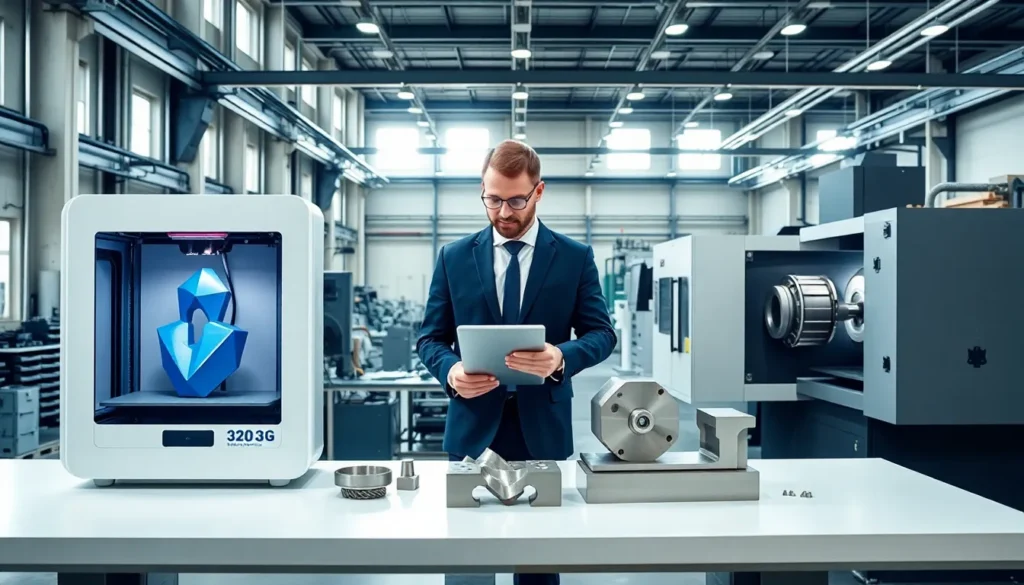
3D printing vs traditional manufacturing represents one of the most significant debates in modern production. Both methods create physical objects, but they achieve this through fundamentally different processes. Traditional manufacturing has dominated industry for over a century. It relies on cutting, molding, and assembling materials. 3D printing, also called additive manufacturing, builds objects layer by layer from digital files.
Businesses today face a choice between these approaches. The right decision depends on project requirements, budget, timeline, and production volume. This article breaks down the key differences between 3D printing vs conventional manufacturing methods. Readers will gain clear insight into how each process works, what it costs, and when to use it.
Table of Contents
ToggleKey Takeaways
- 3D printing vs traditional manufacturing comes down to volume—3D printing is more cost-effective under 100–1,000 units, while traditional methods win at scale.
- 3D printing requires no tooling and can go from concept to physical part in 24 hours, making it ideal for prototyping and rapid iteration.
- Traditional manufacturing delivers superior surface finish, tighter tolerances, and stronger mechanical properties for load-bearing applications.
- Customization favors 3D printing since each item can be unique without additional cost—perfect for medical devices, dental aligners, and specialty products.
- A hybrid approach works best for many businesses: prototype with 3D printing, then shift to traditional manufacturing for high-volume production.
How 3D Printing Works Compared to Conventional Methods
3D printing starts with a digital design file. A printer reads this file and deposits material layer by layer until the object takes shape. The process requires no molds, cutting tools, or assembly lines. Common 3D printing technologies include Fused Deposition Modeling (FDM), Stereolithography (SLA), and Selective Laser Sintering (SLS).
Traditional manufacturing uses subtractive or formative processes. Subtractive methods like CNC machining cut away material from a solid block. Formative methods like injection molding force material into a pre-made mold. Both require significant setup before production begins.
The key distinction in the 3D printing vs traditional debate comes down to flexibility. 3D printers can produce complex geometries that would be impossible with conventional tools. Want internal channels, lattice structures, or interlocking parts? A 3D printer handles these without extra cost or complexity.
Traditional methods excel at speed once setup is complete. An injection mold can produce thousands of identical parts per hour. A 3D printer might take hours for a single piece. This fundamental difference shapes when each method makes sense.
Setup time also differs dramatically. Traditional manufacturing requires tooling, fixtures, and programming. This preparation can take weeks. 3D printing needs only a digital file. Upload it, hit print, and production starts within minutes.
Cost and Time Considerations
Cost structures differ sharply between 3D printing vs traditional manufacturing. Traditional methods have high upfront costs but low per-unit expenses at scale. A single injection mold might cost $10,000 to $100,000. But, each part from that mold costs just pennies.
3D printing flips this equation. Upfront costs stay low since no tooling is required. But per-unit costs remain relatively constant regardless of volume. Printing one part costs roughly the same as printing the hundredth.
This creates a crossover point. Below a certain volume, 3D printing costs less overall. Above that threshold, traditional manufacturing wins on economics. For many products, this crossover happens between 100 and 1,000 units.
Time considerations follow a similar pattern. 3D printing delivers faster for prototypes and small batches. A designer can go from concept to physical part in 24 hours. Traditional manufacturing might require weeks of tooling preparation.
For large production runs, conventional methods prove faster. Mass production lines operate continuously and output thousands of parts daily. 3D printing cannot match this pace for high-volume orders.
Labor costs add another dimension to the 3D printing vs traditional comparison. 3D printing requires less manual labor per part. Traditional manufacturing often needs operators for each machine and assembly workers for final products.
Material Options and Quality Differences
Material selection varies significantly between 3D printing vs traditional processes. Traditional manufacturing works with virtually any material. Metals, plastics, ceramics, composites, and wood all have established production methods.
3D printing has expanded its material range but still faces limitations. Common 3D printing materials include PLA, ABS, PETG, nylon, and various resins. Metal 3D printing exists but costs more and requires specialized equipment.
Surface finish differs between methods. Traditional manufacturing typically produces smoother surfaces. Injection-molded parts have consistent finishes straight from the mold. 3D printed parts often show layer lines and may need post-processing.
Mechanical properties also vary. Traditionally manufactured parts usually have uniform strength throughout. 3D printed objects can have weaker spots between layers. This anisotropic behavior matters for load-bearing applications.
Precision and tolerances favor traditional manufacturing for most applications. CNC machining achieves tolerances of ±0.001 inches. Most 3D printing technologies hold tolerances of ±0.005 inches or wider.
That said, 3D printing continues to improve. Industrial machines now match traditional methods for many specifications. The gap between 3D printing vs conventional quality shrinks each year as technology advances.
Best Use Cases for Each Approach
3D printing excels in specific situations. Prototyping remains its strongest application. Engineers can test designs quickly without committing to expensive tooling. Iteration happens fast when changes require only a file update.
Customization also favors 3D printing vs traditional methods. Medical devices, dental aligners, and hearing aids benefit from patient-specific designs. Each item can be unique without added cost.
Low-volume production suits 3D printing well. Spare parts for vintage equipment, specialty tools, and limited-edition products all make sense. When volumes stay under a few hundred units, 3D printing often wins economically.
Traditional manufacturing dominates high-volume production. Consumer electronics, automotive parts, and packaging all rely on conventional methods. The economics simply work better at scale.
Structural components typically require traditional manufacturing. When strength, durability, and consistency matter most, established methods deliver proven results. Aerospace and automotive industries still depend heavily on conventional processes.
Many companies now use both approaches together. They prototype with 3D printing, then shift to traditional manufacturing for full production. This hybrid strategy captures the benefits of each method.
The 3D printing vs traditional manufacturing choice eventually depends on project requirements. Volume, timeline, material needs, and budget all influence the decision. Smart manufacturers match the method to each specific application.