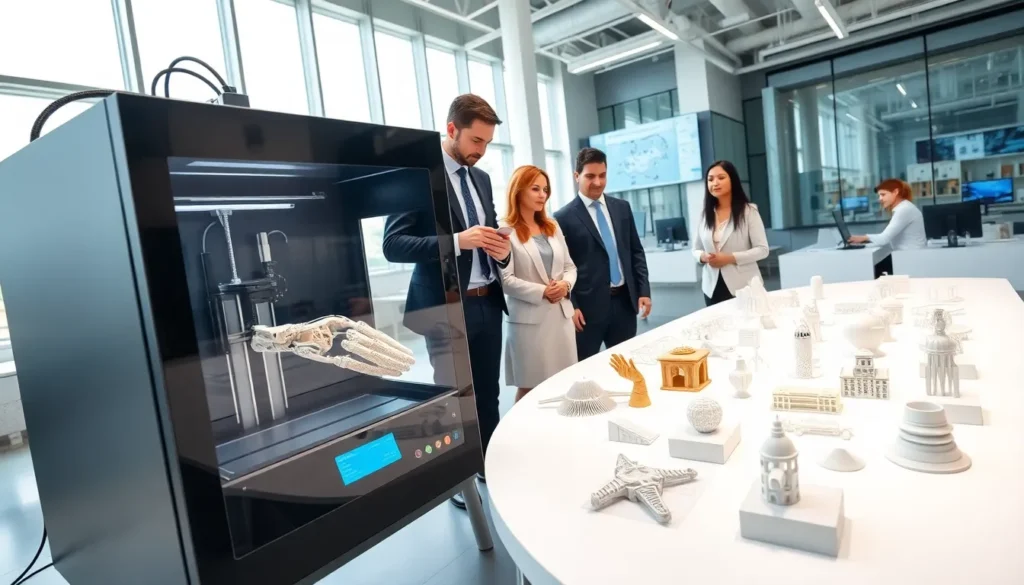
3D printing examples now span nearly every major industry, from healthcare to aerospace. This technology creates physical objects layer by layer from digital designs. What started as a prototyping tool has become a full-scale manufacturing method. Hospitals print custom prosthetics. Car manufacturers produce lightweight components. Architects build detailed scale models in hours instead of weeks.
The applications keep expanding. In 2024, the global 3D printing market reached over $20 billion, and analysts project it will double by 2030. These numbers reflect real adoption across sectors that once seemed unlikely candidates for additive manufacturing. This article explores the most impactful 3D printing examples across six key areas, showing how this technology solves practical problems and creates new possibilities.
Table of Contents
ToggleKey Takeaways
- 3D printing examples now span healthcare, aerospace, automotive, consumer products, architecture, and education, with the global market projected to exceed $40 billion by 2030.
- Healthcare leads with patient-specific surgical models, low-cost prosthetics, dental aligners, and nearly all hearing aids now being 3D printed.
- Aerospace giants like GE Aviation and SpaceX use 3D printing to create lighter, stronger components that reduce production time and fuel costs.
- Consumer products including custom eyewear, 3D printed shoe midsoles from Adidas and Nike, and intricate jewelry demonstrate everyday applications of the technology.
- Full-scale 3D printed homes are now a reality, with companies like ICON building houses in under 48 hours of print time.
- Prototyping and education remain foundational 3D printing examples, allowing students and entrepreneurs to turn ideas into physical objects within days for minimal cost.
Healthcare and Medical Applications
Healthcare offers some of the most striking 3D printing examples today. Surgeons now use patient-specific anatomical models to plan complex procedures. A doctor can hold a replica of a patient’s heart or skull before making the first incision. This preparation reduces surgery time and improves outcomes.
Prosthetics represent another major application. Traditional prosthetic limbs cost thousands of dollars and require multiple fittings. 3D printed prosthetics can be produced for a fraction of that cost, sometimes under $50 for basic designs. Organizations like e-NABLE have provided thousands of 3D printed hands to children worldwide.
Dental applications have grown rapidly too. Orthodontists use 3D printing to create clear aligners, surgical guides, and crown molds. Companies like Align Technology (makers of Invisalign) print millions of dental devices annually.
Bioprinting pushes these 3D printing examples even further. Researchers have successfully printed skin grafts, cartilage, and even miniature organs for drug testing. While fully functional printed organs remain years away, scientists have made steady progress. In 2023, researchers at Tel Aviv University printed a small heart using a patient’s own cells.
Hearing aids showcase mainstream medical adoption. Nearly all hearing aids sold today are 3D printed. The technology allows manufacturers to create perfectly fitted devices from ear canal scans, with production times measured in hours rather than days.
Aerospace and Automotive Manufacturing
Aerospace companies were early adopters of 3D printing, and their applications remain among the most advanced. GE Aviation prints fuel nozzles for jet engines that were previously assembled from 20 separate parts. The 3D printed version is a single piece, lighter, stronger, and more durable.
SpaceX uses 3D printing extensively. The company’s SuperDraco engines feature printed combustion chambers, and many structural components in their rockets come from additive manufacturing. This approach cuts production time and reduces weight, which matters enormously when every gram affects fuel costs.
Automotive manufacturers have embraced 3D printing examples across their operations. BMW prints over 300,000 components annually. Some are prototypes, but many are production parts, things like brackets, fixtures, and custom tools for assembly lines.
Bugatti demonstrated the technology’s potential with a 3D printed titanium brake caliper. The part weighs 40% less than its traditionally manufactured equivalent while handling the same stresses. Ferrari, Porsche, and Lamborghini all use similar applications for low-volume, high-performance components.
Tooling and fixtures offer less glamorous but equally important 3D printing examples. Ford saves millions annually by printing custom jigs and assembly aids. A tool that once required weeks of machining can now be printed overnight. This speed transforms how factories operate and respond to design changes.
Consumer Products and Everyday Items
Consumer products represent the most accessible 3D printing examples for everyday people. Eyewear companies like Materialise produce custom-fitted glasses frames. Each pair matches the wearer’s face dimensions exactly, something impossible with mass production.
Footwear manufacturers have invested heavily in this space. Adidas sells shoes with 3D printed midsoles under its 4DFWD line. New Balance and Nike offer similar products. These soles can be optimized for specific activities, running, basketball, or casual wear, with lattice structures that traditional manufacturing cannot replicate.
Jewelry makers use 3D printing to create intricate designs that would be extremely difficult to produce by hand. The technology enables geometric patterns, interlocking components, and custom pieces at accessible price points. Etsy sellers and established jewelers alike offer 3D printed rings, earrings, and pendants.
Home goods provide practical 3D printing examples too. Companies sell printed lampshades, vases, planters, and organizers. IKEA has experimented with 3D printed accessories for people with disabilities, add-ons that make standard furniture easier to use.
Sporting goods benefit from customization possibilities. 3D printed golf club heads, bicycle components, and protective gear all exist in today’s market. Athletes can get equipment matched to their specific body measurements and playing styles.
Architecture and Construction
Architecture firms use 3D printing examples in two distinct ways: creating models and building actual structures. Scale models that once took weeks of careful craftsmanship can now be printed in days. Architects iterate faster and communicate designs more clearly to clients.
Full-scale 3D printed buildings have moved from concept to reality. ICON, a Texas-based company, has printed multiple homes in the United States. Their Vulcan printer extrudes concrete in layers, creating walls for houses in under 48 hours of print time. A community in Austin features several ICON-printed homes that sell at market rates.
Dubai has committed to having 25% of new buildings constructed using 3D printing by 2030. The city already hosts the world’s largest 3D printed building, a two-story administrative facility measuring over 6,500 square feet.
These construction 3D printing examples offer several advantages. Labor requirements drop significantly. Material waste decreases because printers deposit only what’s needed. Curved and organic shapes cost the same as straight walls, opening new design possibilities.
Infrastructure projects benefit too. Engineers have printed pedestrian bridges in Spain and the Netherlands. These structures demonstrate that 3D printing can handle load-bearing applications, not just cosmetic elements. The technology particularly suits remote locations where transporting traditional building materials proves difficult.
Education and Prototyping
Education settings provide foundational 3D printing examples that shape future applications. Schools from elementary through university level use printers to make abstract concepts tangible. Students can hold molecular structures, historical artifacts, and mathematical shapes.
Engineering programs rely heavily on 3D printing for design courses. Students prototype ideas quickly, test them, and iterate. This hands-on process teaches manufacturing principles better than textbooks alone. MIT, Stanford, and thousands of other institutions maintain print labs for student use.
Prototyping remains the original and still most common application. Product designers print functional prototypes to test form, fit, and sometimes function before committing to expensive tooling. A startup can validate a product concept for a few hundred dollars instead of tens of thousands.
Small businesses benefit from these 3D printing examples particularly. An entrepreneur with a new gadget idea can print prototypes at home or through services like Shapeways and Xometry. This accessibility has democratized product development. Ideas that would have stayed sketches a decade ago now become physical objects within days.
Makerspaces and community workshops have spread 3D printing access widely. These shared facilities let hobbyists, inventors, and small business owners use equipment they couldn’t afford individually. The result is a growing population comfortable with additive manufacturing and its possibilities.